Somalia’s journey to rebuild its public financial management (PFM) system represents one of the most significant pillars of its post-conflict state-building process. After more than two decades of institutional collapse following 1991, the formation of the Federal Government in 2012 marked the beginning of a deliberate effort to restore fiscal order, rebuild governance systems, and re-establish public trust. Since 2013, Somalia has embarked on a comprehensive reform program aimed at strengthening financial discipline, enhancing transparency, modernizing revenue systems, and aligning its fiscal framework with international standards.
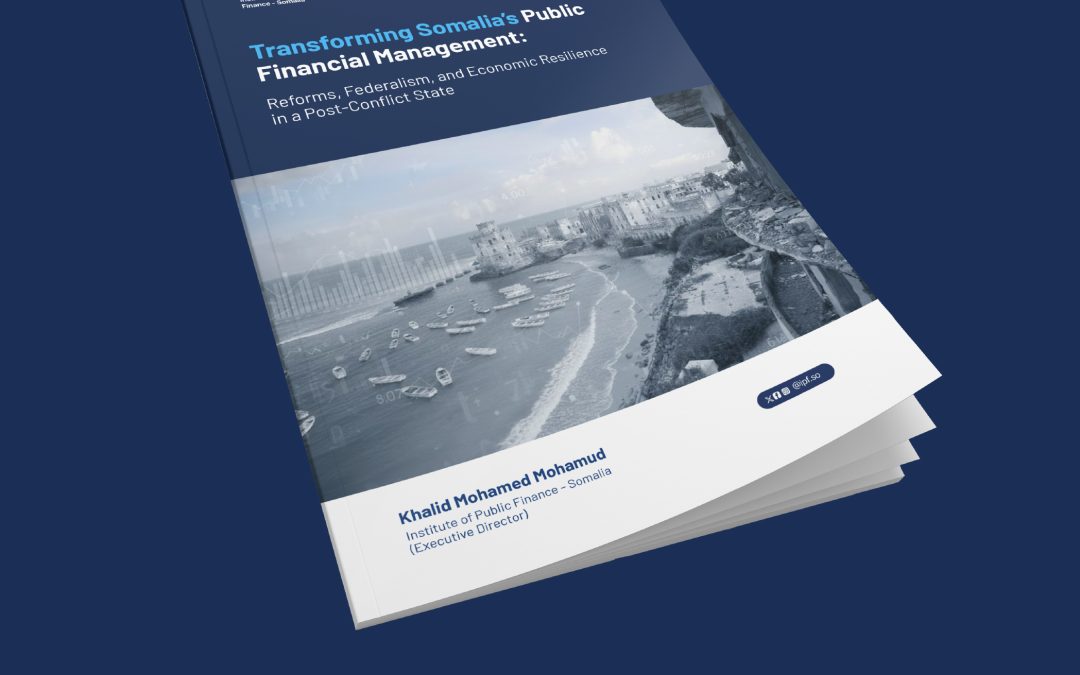
This reform process, documented in Transforming Somalia’s Public Financial Management: Reforms, Federalism, and Economic Resilience, highlights both the remarkable progress achieved and the challenges that remain in building a resilient and accountable financial system.
Rebuilding the Legal and Institutional Framework
One of the most important milestones in Somalia’s PFM reform was the enactment of the Public Financial Management Act in 2019. This legislation established a modern legal foundation for budgeting, expenditure control, accounting, reporting, and financial oversight. Complemented by detailed financial regulations approved in 2022, the new framework clarified institutional roles, formalized the budget process, strengthened treasury management, and reinforced fiscal discipline.
Additional legislation—including procurement reforms and revenue laws—further enhanced governance standards and reduced opportunities for financial mismanagement. The revival of the Office of the Auditor General and the publication of consecutive audited financial statements marked a historic shift toward transparency. For the first time in decades, Somalia demonstrated a functioning system of external audit and public financial reporting.
These institutional reforms were critical not only for domestic governance but also for rebuilding credibility with international partners.
Digital Transformation: Modernizing Financial Systems
Somalia leveraged technology as a cornerstone of its PFM reforms. The introduction of the Somalia Financial Management Information System (SFMIS) replaced fragmented and manual financial processes with an integrated digital platform capable of tracking revenues and expenditures in real time.
The implementation of a Treasury Single Account (TSA) centralized government cash management, improving fiscal control and eliminating off-budget accounts. On the revenue side, the rollout of automated customs systems and mobile money payment options modernized tax collection and significantly reduced leakages.
The use of digital tools not only strengthened internal controls but also expanded domestic revenue mobilization. Over the past decade, domestic revenue has grown substantially in absolute terms, reflecting improved compliance, better administration, and enhanced oversight.
Fiscal Federalism: An Ongoing Challenge
While governance and digital reforms have advanced, fiscal federalism remains one of Somalia’s most complex and unresolved reform areas. The federal system requires clarity on revenue assignments, expenditure responsibilities, and intergovernmental transfers between the Federal Government and Federal Member States.
Although interim agreements on resource-sharing—particularly in areas such as natural resources and customs—have been reached, a comprehensive and codified fiscal federalism framework has yet to be finalized. The absence of a fully agreed revenue-sharing model continues to create uncertainty and occasional tensions between levels of government.
Strengthening fiscal coordination, harmonizing tax systems, and building capacity at the state level are essential next steps to ensure that financial resources are distributed equitably and managed effectively across the country.
Alignment with International Standards and Debt Relief
Somalia’s reforms have been closely aligned with international best practices. The adoption of international public sector accounting standards, harmonized budget classifications, and improved financial reporting frameworks positioned Somalia to meet global transparency benchmarks.
This alignment played a critical role in Somalia’s successful attainment of the Heavily Indebted Poor Countries (HIPC) Completion Point in 2023, resulting in the cancellation of billions of dollars in external debt. Debt relief has significantly improved Somalia’s macroeconomic outlook, restored financial credibility, and opened new pathways for concessional financing and development partnerships.
International partners—including the World Bank, IMF, African Development Bank, European Union, and bilateral agencies—provided technical assistance and capacity-building support throughout the reform process. However, Somalia’s leadership and sustained political commitment were central to driving progress.
Economic Impact and Remaining Gaps
The reforms have yielded measurable economic benefits. Fiscal discipline has improved, revenue collection has increased, and budget execution has become more predictable. Somalia now operates within tighter fiscal controls, reducing the risk of unsustainable deficits and improving macroeconomic stability.
Despite these gains, challenges persist. Domestic revenue remains low relative to GDP, limiting the government’s ability to finance essential services independently. Security expenditures and recurrent costs continue to consume a large share of the budget, leaving limited fiscal space for infrastructure, health, and education investments.
Moreover, improvements in financial governance must increasingly translate into tangible service delivery outcomes that directly benefit citizens. Sustainable reform requires not only stronger systems, but also better allocation of resources toward development priorities.
Lessons from Post-Conflict Reform
Somalia’s experience mirrors lessons observed in other post-conflict countries: foundational financial controls must be established before more advanced reforms can succeed. Sequencing matters. Political commitment matters. External incentives—such as debt relief—can accelerate progress, but lasting reform depends on domestic ownership and institutional capacity.
The Somali case demonstrates that even in fragile contexts, substantial improvements in PFM are possible when reforms are pragmatic, technology-driven, and grounded in accountability.
The Road Ahead
To consolidate and deepen progress, several priorities stand out:
- Finalizing and formalizing a fiscal federalism framework
- Broadening the tax base and modernizing tax administration
- Strengthening financial management capacity at sub-national levels
- Enhancing parliamentary and civil society oversight
- Expanding digital financial systems and integrated platforms
- Safeguarding reforms against political reversal
Ultimately, public financial management is more than a technical system of budgets and accounts—it is a foundation for governance, economic resilience, and national stability. Somalia’s progress over the past decade demonstrates that rebuilding financial institutions is possible even after prolonged conflict.
As the country continues its state-building journey, sustaining and deepening PFM reforms will be essential to transforming fiscal gains into inclusive development, improved public services, and long-term prosperity for the Somali people.
Download full report here