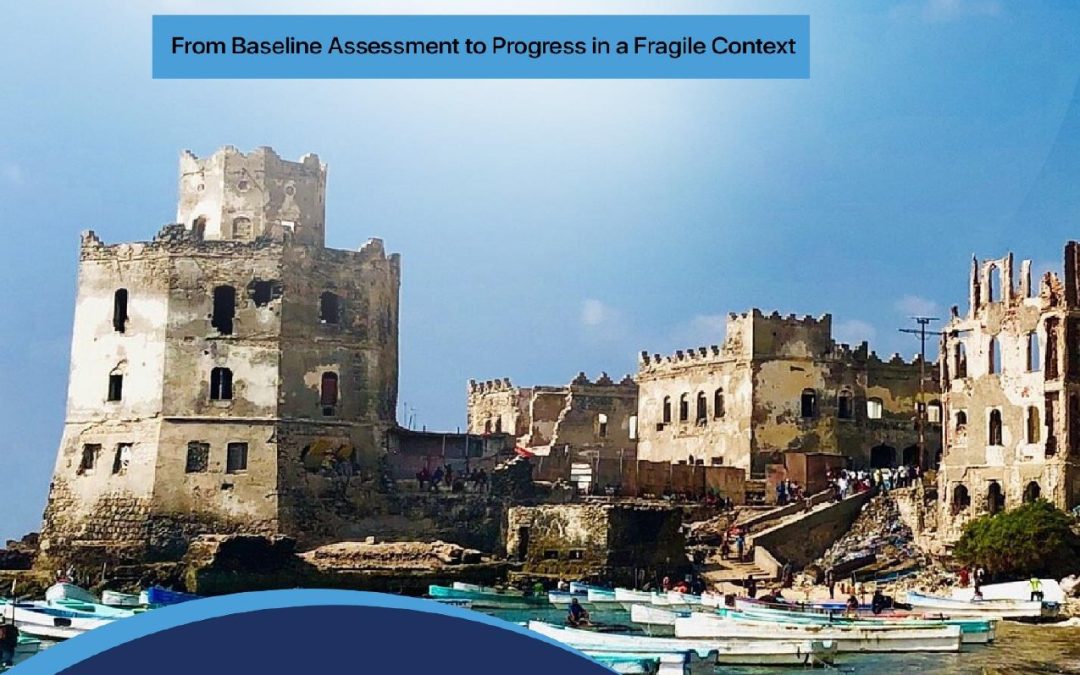
The Banadir Regional Administration (BRA), which governs Mogadishu, has undertaken a significant Public Financial Management (PFM) reform program in a highly fragile, post-conflict environment. This report documents BRA’s reform journey from an extremely weak PFM baseline in 2023 to measurable institutional improvements achieved by April 2025.
The analysis is based on a 2023 PFM assessment conducted using the Public Expenditure and Financial Accountability (PEFA) framework, combined with a review of reform implementation, donor benchmarks, and institutional progress over the subsequent two years. A qualitative case study methodology was adopted, drawing on official documents, reform status reports, donor compliance records, and comparative PEFA analysis.
Baseline Situation (2023)
The 2023 assessment revealed a PFM system at a very early stage of development. All core PFM areas were rated at the lowest PEFA level. BRA operated without a formal PFM legal framework, standardized budget processes, effective expenditure controls, or reliable financial reporting. There was no history of annual financial statements or external audit, revenue management was fragmented and partially off-budget, procurement systems were weak, and intergovernmental fiscal transfers were unpredictable. These weaknesses significantly undermined fiscal discipline, transparency, and accountability.
Reform Progress (2023–2025)
Between 2023 and 2025, BRA implemented a focused set of reforms with support from national institutions and international partners. Key achievements include:
-
Introduction of a unified chart of accounts aligned with federal standards
-
Standardization of the budget process through manuals and budget calendars
-
Timely approval and publication of annual budgets, including citizen-friendly budgets
-
Establishment of commitment controls and regular in-year budget execution reporting
-
Preparation of BRA’s first-ever annual financial statements
-
Completion of the first external audit in BRA’s history
-
Adoption of procurement policies and initiation of competitive tendering
-
Creation of an asset register and an internal audit function
-
Improvements in revenue administration and on-budget reporting
-
Enhanced fiscal transparency through public disclosure and engagement
-
Stronger participation in intergovernmental fiscal coordination mechanisms
Results and Comparative Performance
A comparative analysis indicates substantial improvement across multiple PEFA dimensions. Many indicators plausibly improved from “D” ratings in 2023 to “C” or “B” levels by 2025, particularly in budget classification, transparency, in-year reporting, annual financial statements, and external audit. These institutional gains translated into increased confidence from development partners.
BRA successfully met key World Bank and European Union budget support conditions, resulting in the disbursement of significant fiscal resources. The reforms created a virtuous cycle in which improved financial management strengthened donor confidence, which in turn enabled further reform and service delivery investments.
Broader Implications
BRA’s experience demonstrates that meaningful PFM reform is achievable even at the sub-national level in fragile and post-conflict settings when reforms are well-sequenced, politically supported, and technically assisted. The case reinforces lessons from international experience: prioritize foundational systems, leverage external incentives strategically, build local capacity through learning-by-doing, and link PFM improvements to transparency and accountability.
Conclusion
The Banadir Regional Administration has transitioned from an ad-hoc and opaque financial management system to a nascent but functioning PFM framework aligned with recognized standards. While challenges remain—particularly in legal codification, FMIS modernization, and predictable intergovernmental fiscal arrangements—the progress achieved between 2023 and 2025 represents a decisive step toward stronger local governance, improved service delivery, and sustainable state-building in Mogadishu.
This report contributes to the growing body of evidence that effective PFM reform can serve as a cornerstone for recovery and governance in fragile contexts, offering valuable lessons for Somalia and comparable post-conflict environments.