
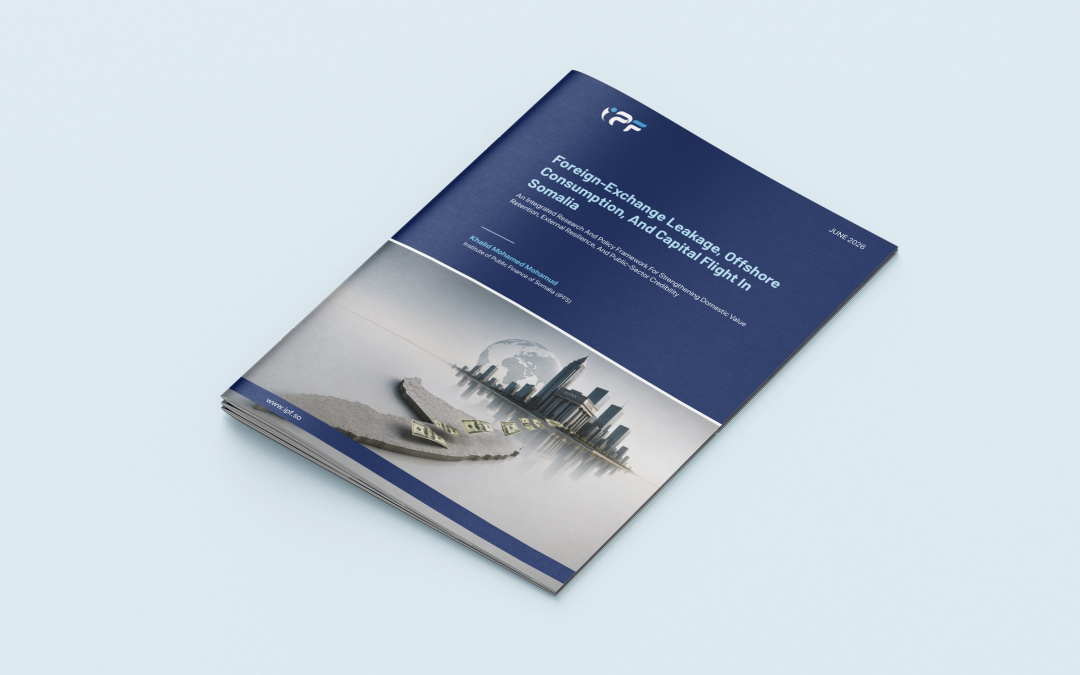
1. Core Thesis
The paper argues that Somalia’s economic fragility is fundamentally a “domestic value-retention problem.”
A large share of income generated inside the country is continuously spent abroad on imports, services, and external assets, creating persistent foreign-exchange (FX) leakage.
2. Key Concepts
Foreign-Exchange Leakage
Outflows of foreign currency due to:
- Imports of goods
- Payments for foreign services
- Offshore consumption
- Capital flight risks
Offshore Consumption
Legitimate spending abroad by households and firms:
- Education
- Healthcare
- Travel
- Business services
Capital Flight (Risk, not fully measured)
Illicit or unrecorded outflows such as:
- Trade misinvoicing
- Hidden foreign asset accumulation
- Corruption-related transfers
The paper emphasizes measurement discipline, distinguishing:
- Recorded flows
- Observable proxies
- Unobserved risks
3. Empirical Findings (2024 Data)
3.1 Trade Imbalance (Main Leakage Source)
- Imports: $9.18 billion
- Exports: $1.56 billion
- Trade deficit: $7.62 billion
- Export coverage: 17% (exports finance <1/5 of imports)
➡️ Indicates extreme dependence on foreign goods
3.2 Services Deficit (Offshore Consumption)
- Service credits: $1.34 billion
- Service debits: $2.32 billion
- Net services deficit: ~$0.98 billion
➡️ Reflects spending abroad on:
- Health
- Education
- Logistics
- Travel
3.3 Total Recorded FX Leakage
- Trade deficit + services deficit ≈ $8.61 billion
➡️ Represents gross demand for foreign output before remittances/grants
3.4 Khat Imports (Discretionary Leakage)
- Value: $400 million
- Share:
- 4.4% of imports
- 25.7% of exports
➡️ A recurrent, non-essential FX drain
3.5 Fiscal Structure Problem
- Domestic revenue: $369 million
- Wage bill: $342 million (92.5% of revenue)
- Capital investment: $28.5 million (3.2% of spending)
➡️ This creates a “wage trap”:
- Government can operate
- But cannot invest in productivity or export capacity
4. Structural Drivers of Leakage
4.1 Import Dependence
- Weak domestic production
- Limited industrial base
4.2 Weak Services Sector
- Lack of:
- Hospitals
- Universities
- Logistics systems
➡️ Forces spending abroad
4.3 Trade Misinvoicing
- Underinvoiced exports
- Overinvoiced imports
➡️ Used to move money abroad
4.4 Public Sector Leakages
- Government travel
- Overseas procurement
- Weak accountability
4.5 Governance & Data Constraints
- Limited statistical systems
- Lack of transaction-level data
➡️ Capital flight cannot be precisely measured
5. Conceptual Insight
The paper reframes the issue:
The problem is not just deficits—it is how domestic income converts into foreign demand.
Thus, leakage ≠ current account deficit
It is a structural transformation issue.
6. Policy Framework: “Domestic Value Retention Strategy”
6.1 Guiding Principles
- Not isolationist
- Maintain openness
- Reduce avoidable leakages
- Build domestic capacity
6.2 Core Policy Pillars
1. Tariff & Excise Reform
- Low tariffs: essentials (food, medicine)
- High taxes: luxury goods & khat
- Structured, transparent system
2. Customs Modernization
- Digital systems (e-declarations)
- Risk-based inspections
- Valuation databases
- Anti-smuggling enforcement
3. Khat Demand Reduction
- Excise taxes
- Public health campaigns
- Controlled regulation (not prohibition)
4. Export Promotion
Focus sectors:
- Livestock
- Crops (e.g., sesame)
- Fisheries
Tools:
- Certification
- Cold chains
- Logistics improvements
5. Services Substitution
Invest domestically in:
- Healthcare
- Education
- Finance
- Logistics
➡️ Reduces need to spend abroad
6. Fiscal Reform
- Increase capital investment
- Reduce wage dominance gradually
- Improve procurement transparency
7. Control Public Offshore Spending
- Travel caps
- Digital payments
- Asset declarations
- Procurement controls
8. Financial Integrity Systems
- Monitor outward transfers
- AML/CFT frameworks
- Beneficial ownership transparency
7. Implementation Strategy
Phased Approach
- 0–12 months: Data systems, credibility
- 12–24 months: Enforcement & quick wins
- 24–48 months: Domestic production
- 36–60 months: Export transformation
Institutional Setup
- FX Leakage Reduction Taskforce
- Multi-agency coordination
- Quarterly public dashboard
8. Expected Impact (Illustrative)
- Reform could reduce trade deficit by ~$3.3 billion by 2029
9. Monitoring Framework
Key indicators:
- Trade deficit
- Export performance
- Khat imports
- Services deficit
- Wage bill ratio
- Capital spending
- Outward transfers
➡️ Emphasis on transparency and aggregated data reporting
10. Limitations of the Study
- Incomplete data (informal trade, smuggling)
- No precise estimate of capital flight
- Relies on proxies and official statistics
11. Final Conclusion
- Somalia’s challenge is systemic external leakage, not just fiscal imbalance.
- Sustainable solution requires:
- Better data
- Stronger institutions
- Domestic production
- Reduced reliance on foreign goods/services
Goal: Keep more Somali-generated income circulating within the domestic economy.
Bottom Line
Somalia’s economy is constrained by:
- Heavy import dependence
- Weak domestic services
- Limited productive investment
The proposed solution is a coordinated, multi-sector reform strategy aimed at: 👉 Reducing FX leakage
👉 Building domestic capacity
👉 Transforming the structure of demand and production